

Certification Guide
Every stone is graded before it is set.
An independent laboratory measures and records each diamond we use. This page explains what is on that report, who issues it, and how to read it.
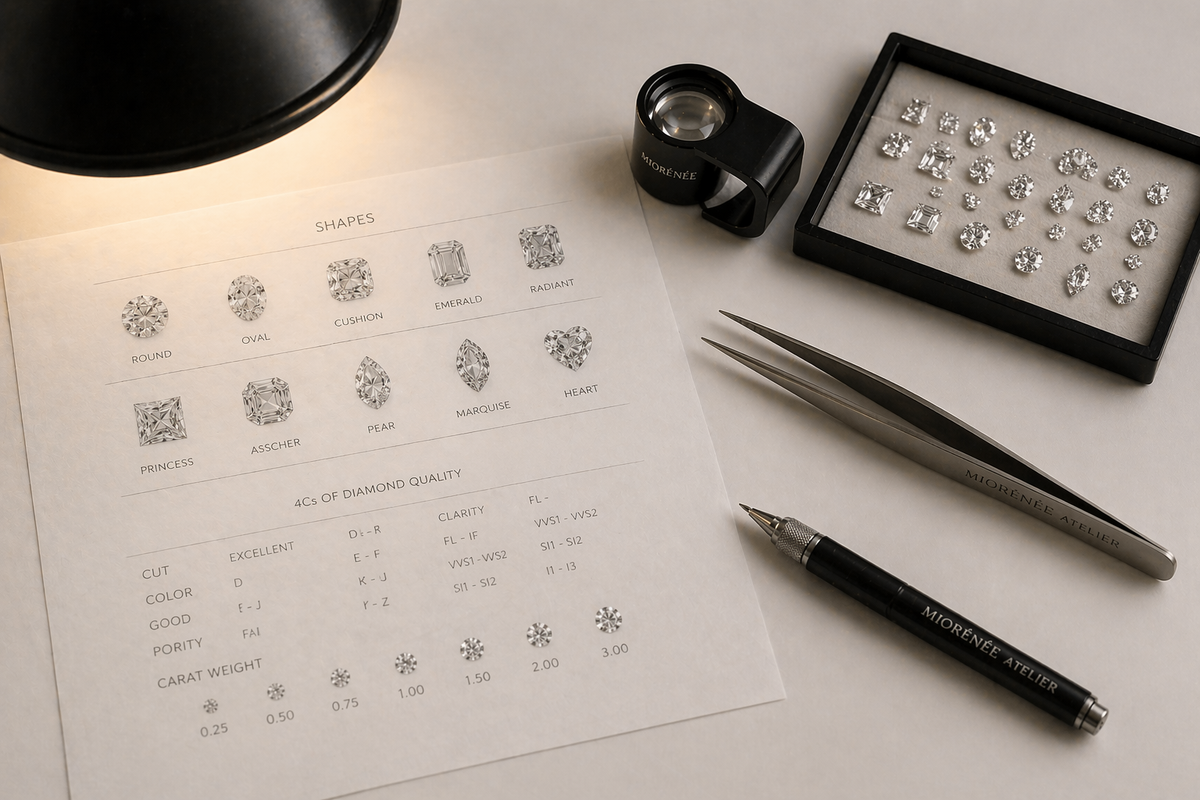
The Report
What the certificate records.
A grading report is an independent evaluation from a gemological laboratory. It documents the stone's measurable characteristics and carries a unique number, laser-inscribed on the girdle, so the report and the diamond can always be matched.
Carat weight
Weight, measured in carats. One carat is 200 milligrams.
Cut grade
How the facets interact with light. Graded Excellent to Poor.
Color grade
The absence of color, from D (colorless) down through the alphabet.
Clarity grade
Inclusions and blemishes, from Flawless (FL) to Included (I3).
Measurements
Exact dimensions in millimeters, with depth and table percentages.
Fluorescence
Any visible emission under ultraviolet light, from None to Very Strong.
The Laboratories
Who does the grading.
We set lab-grown and natural diamonds. Lab-grown stones are graded by IGI, natural stones by GIA. Both reports record the full 4Cs.
IGI
International Gemological Institute. Headquartered in Antwerp, with laboratories worldwide. Issues full 4Cs reports for lab-grown diamonds.
GIA
Gemological Institute of America. Established in 1931 and author of the 4Cs grading system, which it continues to apply to natural diamonds.

The Split
Why the laboratory differs by stone.
In October 2025 GIA stopped applying the 4Cs to lab-grown diamonds, replacing individual color and clarity grades with a two-tier assessment. IGI continues to issue full grades: color, clarity, cut, polish and symmetry. So lab-grown goes to IGI and natural to GIA, and either way the report carries a grade you can compare.
Natural Diamonds
Natural diamonds, made to order.
Pieces set with natural diamonds are made to order. Those stones are graded by GIA, which continues to apply the full 4Cs to natural diamonds. Give us the specification and we will source to it.
Why It Matters
What the report is for.
A report lets you compare stones on the same terms rather than on description, and gives you a document for insurance and valuation. It is also what allows us to state a stone's grade instead of describing it.
Every stone we set is certified.
The report number for any piece is available on request, and the inscription on the girdle matches it.
Explore Collections